This article, authored by Craig DiLouie, LC, was published in the October 2014 issue of tED Magazine. Reprinted with permission.
Outdoor lighting control is undergoing a mini-revolution that offers electrical distributors new selling opportunities while challenging them to keep abreast of technological change.
Traditionally, controlling an outdoor lighting system was a relatively simple affair. Typically, the controller provided automatic ON/OFF based on time of day (astronomical time switch) or presence of daylight (photosensor). Luminaires were typically controlled at the circuit level, with no individual luminaire control.
“All of this has changed,” says Bryan Pike, senior product line manager for WattStopper, “with new code mandates for sophisticated control sequences of outdoor lighting and the increased controllability of new LED light sources.”
The biggest sales opportunities for outdoor lighting control, he points out, are municipal street and roadway lighting, parking facilities, park site lighting, large municipal and commercial facilities, and automotive dealerships.
Commercial building energy codes as or more stringent than ASHRAE/IES 90.1-2010, the national energy standard, require all outdoor lighting be controlled by a photosensor. Building facade and landscape lighting must also be controlled by a time switch that turns the lights OFF within a given window of time during the night.
ASHRAE/IES 90.1-2010 also requires that all outdoor lighting power (other than building facade and landscape lighting, but including advertising signage) be reduced by at least 30 percent after normal business operations either based on a schedule or occupancy. Parking garage lighting power must be reduced by at least 30 percent based on occupancy, with lighting grouped in control zones no larger than 3,600 sq.ft. Additionally, daylight harvesting for parking garage daylight zones and separate control for daylight transition areas (entrances/exits) must be provided.
These simple requirements, which can save significant amounts of energy, have created demand for sensors, individual luminaire control and controllability while increasing the complexity of design of outdoor lighting control systems. The resulting products and experience gained from these projects offer ready-made solutions for projects in areas with less stringent codes, providing another path to energy cost savings.
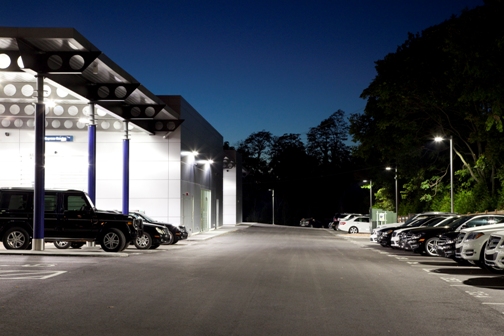
Outdoor lighting control is trending toward individual multilevel control. At the Collection Auto Group Fort Mitchell dealership, the lights dim to 10 percent of light output at night (schedule) but automatically ramp up to full output if a vehicle approaches (occupancy sensing). Image courtesy of GE Lighting.
Manufacturers have responded with new technologies well suited to outdoor lighting control, including wireless and intelligent lighting control. These technologies provide an ideal match with outdoor LED lighting that continues to increase in popularity and performance. For best results, distributors should not regard outdoor lighting and control as an isolated aspect of the building but rather part of a total integrated system.
“The best solution is to deploy an integrated wireless solution that can incorporate all control strategies, such as ON/OFF, dimming, photocell control, occupancy and scheduling,” says Tom Braz, VP and general manager for Hubbell Building Automation. “These systems allow easy access to the system for future changes and fine tuning. A lower-cost solution would be individual fixture control where the control device comes attached to the fixture and can still provide occupancy and photocell control. The lowest-cost method would be to install a lighting control panel that can provide photocell and scheduling control.”
He points out that wireless is optimal because it enables implementation of all control strategies, with the ability to control each luminaire individually, while eliminating the need to deliver a control wire to every luminaire.
Rick Freeman, global product general manager of intelligent devices for GE Lighting, adds that wireless control enables two-way communication, which provides opportunities for monitoring and robust back-end management features.
“With new outdoor lighting systems that integrate controls with GPS locators, the fixtures suddenly become assets rather than simply a light source,” he says. “Outdoor lighting control systems can help cities and utilities realize where all their fixtures are at a given time and what kind they are, along with precise details on power sources, manufacturer and more. Given this information, it helps to assist with predictive maintenance schedules by alerting maintenance crews when a fixture is failing, as well as the specific type of fixture/bulb to help crews optimize their travel and maintenance time.”
Systems such as these are supported by a web-based interface that enables operators to remotely visualize real-time performance, set schedules, zone luminaires in groups, and generate custom reports that can optimize management of outdoor lighting as an asset. In the wireless control realm, ZigBee, 6LoWPAN, proprietary and cellular approaches are all on in various stages of implementation.
Wireless control can also facilitate implementation of sophisticated lighting control solutions for existing properties, as trenching and installing wiring isn’t needed. When upgrading outdoor lighting, distributors should look for opportunities to bundle controls. Utility rebates are available for outdoor as well as indoor controls.
“When assessing challenges and solutions, a distributor can add value to the project team by considering other specifics, such as what control sequences of operation may be desired, if there’s a need for multilevel lighting control, and what needs may exist for predictive maintenance, security or merchandising,” says Pike. “These factors will all influence the specific solution that may be ideal for a particular application.”
Freeman agrees. “Electrical distributors will see controls and LED retrofit go hand in hand,” he says. “They have opportunities to expand their businesses beyond what is on their shelves by providing more services for planning, installing and commissioning lighting controls. Customers are eager for the solution but do not want to have to piece it together themselves—this is where an electrical distributors can take advantage to be the expert resource and build a custom solution that integrates lighting control systems.”
The popularity of LED lighting is also facilitating other technological change. Advances in standards and technology for the Internet of Things will provide opportunities to integrate other devices within LED luminaires, such as sensors, security cameras and audio. Integrating and designing these systems will be a challenge, however, and it is difficult for some owners to understand the value of the kinds of data that can be produced until they actually have the data in hand, creating a Catch-22.
Further, occupancy sensing for outdoor lighting, currently limited to passive-infrared sensing technology, may expand with options for digital imaging (non-recording video), which offers more precise detection in the dynamic outdoor environment.
“Lighting fixtures and lighting controls are no longer separate things,” says Braz. “The customer views their lighting applications as a system. Our industry should approach every customer with a system solution. Every discussion should include a value proposition of integrated lighting fixture and control.”
Freeman adds, “Don’t think of it as control. Think of it as sensing, decision making, control and prediction. It is a solution where data and applications are very important.”
Leave a Reply